Snook Spawning Aggregations in June: Fish the Passes Without Killing the Spawn
 Hudson Reed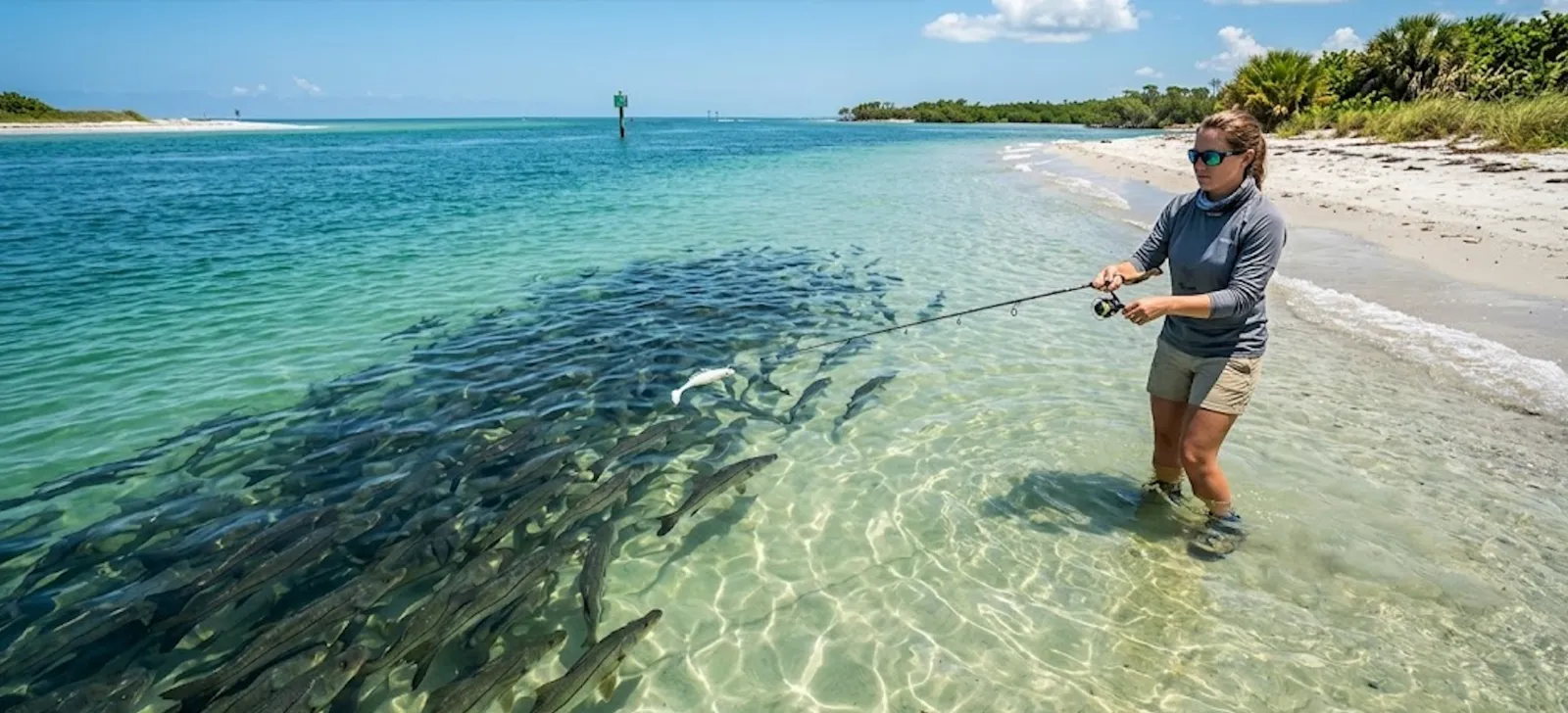
Written by Hudson Reed
It's the second week of June at Sebastian Inlet, the outgoing is two hours into a new-moon push, and the bridge lights are throwing shadow lines into the cut. A pod of 30-inch snook holds in the slack water behind the piling. They're not feeding so much as staging. This is what Florida snook spawning aggregations look like in June, and it's also why you need to think harder before you pick up a rod than you do any other month of the year.
Snook season is closed statewide through the heart of summer. Every fish you touch in June is a catch-and-release fish, every fish in the aggregation is either about to spawn or recovering from a spawn, and the cryptic-mortality math says we are killing more snook this month than any other. Fish them carefully, fish them briefly, or pick another target in the same water.
When is Florida snook season actually closed in 2026?
Both coasts are closed for harvest through the summer spawn, but the dates are not identical. According to the FWC 2026 snook regulations:
- Atlantic coast (Northeast, Indian River Lagoon, Southeast regions): closed June 1 through August 31.
- Gulf coast (Panhandle, Big Bend, Tampa Bay, Sarasota Bay): closed May 1 through August 31.
- Charlotte Harbor and Southwest Gulf: closed May 1 through September 30.
That gap matters. If you're running from Sanibel up to Boca Grande, you've been catch-and-release since the first of May. If you're at Jupiter Inlet, June 1 is the door slamming shut. Confirm before you launch. FWC has corrected season dates by emergency rule before, and the 2026 regulations are the only ones that count.
Why do snook stack at the passes in June?
Snook are estuary fish for most of the year. They spawn in salt. To pull that off, mature fish migrate out of the backcountry rivers and bays to high-salinity choke points (inlets, passes, beach-adjacent structure) where outgoing tides can carry fertilized eggs offshore to develop. Salinity has to be roughly 20 parts per thousand or higher for eggs to survive, which is why aggregations form at the same handful of locations every single summer.
FWC's acoustic-telemetry work in Jupiter and Lake Worth inlets has documented individual aggregations holding several thousand adult snook, with the same tagged fish returning to the same inlet for as many as five consecutive years. Individuals stage at the spawning site for 40 to 70 days, spawn multiple times around dusk, then migrate back inland.
The science is unambiguous on this one. These are not random fish. They are reproductive adults that the fishery depends on, concentrated in a small footprint, predictably, every June and July.
The big-name aggregation sites
On the Gulf coast: Boca Grande Pass, Captiva Pass, Blind Pass, Big Carlos Pass, the Sanibel beaches, and the passes around Naples. On the Atlantic side: Sebastian Inlet, Fort Pierce Inlet, the St. Lucie, Jupiter Inlet, and Lake Worth Inlet. The pattern repeats up and down both coasts. If a tidal cut has 20-foot-plus depth, hard structure, and a clean outgoing flush to open water, it holds snook in June.
The ethics of fishing snook spawning aggregations
Here's the uncomfortable part. The FWC's own cryptic-mortality research estimates that roughly 43% of total snook harvest is lost annually to mortality on released fish, and the agency notes the real figure is likely closer to 50% when you account for the same fish being caught multiple times in a season. A spawning aggregation is the worst possible context for that math: stressed fish, summer water temps in the 80s with less dissolved oxygen, gametes being burned through fight time that should have gone into the next batch of eggs.
You can fish these aggregations responsibly. You can also skip them.
My take, after a lot of summers chasing them: if the water temp at the surface is north of 85 degrees and you're already three fish into a session, you've gotten what you came for. Walk down the beach. Throw at jacks or ladyfish. There are juvenile tarpon rolling in the same backwater you just left. Adult tarpon are happily eating crabs in the passes you just fished. Snook on aggregation in late June are not the only game on the coast, and they are the most expensive one to play.
If you're going to fish them, fish them like you mean it.
You might also enjoy: Best Kids Fishing Rod and Reel Combo for 2026: Dock Demon vs Ugly Stik GX2 vs PLUSINNO
"Cryptic mortality during the closed season can substantially reduce the spawning potential of the fishery. We should be doubly diligent in using proper catch-and-release techniques when fishing for large reproductive snook."
Florida Fish and Wildlife Conservation Commission, Cryptic Mortality and Its Effects
How do you fish a flair hawk in a moving pass?
The flair hawk is the pass jig. It's been the pass jig since Bob Lemay was tying them on Miami bridges in the 1970s, and nothing has replaced it because nothing needs to. Marabou breathes on the drop, the bucktail-and-flash skirt pulses on the swim, and the lead head punches the jig down into the strike zone faster than anything plastic will.
Match the jig weight to the current, not the depth. A standard rule:
- 1 to 1.5 oz: slack tide, light current, clear water
- 2 oz: the workhorse, two hours into an outgoing on a normal moon
- 3 to 4 oz: full or new moon, peak outgoing, ripping current at Boca Grande or Sebastian
Cast up-current, across the seam, and let the jig swing on a controlled fall. You want the head ticking the bottom on the swing, not dragging through sand. The eat is almost always within a foot of the bottom and it's almost always on the slow lift. White is the default color in clear water. Switch to chartreuse or pink when the tide pulls in dirty water from the backcountry.
Two things will improve your hookup rate more than anything else. Fish the first two hours of the outgoing off high tide. That's when bait moves and the snook position to ambush it. And cast at the structure, not the open water. Bridge fenders, pass pilings, the deep cut on the inside of the channel bend. Snook are facing the current, holding behind something solid, and waiting for an easy meal to drift past.
The gear-up checklist
- Rod: 7'6" to 8' medium-heavy with a fast tip. You need backbone to lever a 35-inch fish out of pilings before she breaks you off.
- Reel: 5000 to 6000-class spinning or a 300-class baitcaster, spooled with 40 to 50-lb braid.
- Leader: 50 to 60-lb fluorocarbon, four to five feet, FG-knotted to the braid. Snook have sandpaper jaws and a sharp gill plate; a 30-lb leader gets sliced on the second head shake.
- Jig: 2 oz flair hawk, white or chartreuse, with a stout 5/0 hook. Sharpen it before you leave the truck.
- Tools: long-handle dehooker, lip grip with a built-in scale, and a phone in a waterproof pouch (not in your hand over the water).
How do you sight-cast beach snook on a low tide?
Different game entirely. While the big females are stacked at the passes, smaller males and mid-sized fish cruise the trough on the beach side, often in a foot of water you can wade. This is the most visual snook fishing you'll do all year.
The window is the bottom half of an outgoing tide on a clean morning, before the wind builds. Walk the wet sand parallel to the swash, looking through your polarized lenses for dark shapes that don't match the bottom. Snook on the beach in June run in singles, pairs, and short conga lines of 4 to 8 fish strung along the trough.
Lead them. Cast three to six feet ahead of the fish, never on top of them. A small white paddletail on a 1/4-oz jighead is the most forgiving rig. Twitchbaits and small flies work too, but the soft plastic gives you the broadest range of retrieves (slow swim, dead stick, gentle twitch) and the fish will tell you which one they want.
The mistake everyone makes on beach snook is the second cast. You missed the eat on the first one, the fish spooked off the trough, and you fire again into the same patch of water. Don't. Walk 30 yards, find a fresh fish, and start over. Beach snook that have been cast at three times are done for the day.
Releasing a spawning snook so she actually lives
This is the part of the post that matters more than everything above it. If you take only one thing from this, take this section.
Snook are tougher than redfish but more fragile than tarpon. The vertical lip-hold that shows up in every truck-bed hero shot is the single biggest cause of release mortality. It dislocates the jaw, damages the connecting tissue, and turns a healthy spawning female into a fish that swims off and dies a week later in the mangroves. Don't do it. Support the fish horizontally with a wet hand under the belly, the other hand cradling the head, and keep her in the water if at all possible.
You might also enjoy: Best Braided Fishing Line for Bass and Inshore 2026: Power Pro vs Sufix 832 vs Daiwa J-Braid
Hard rules for the closed season:
- Crimp your barbs. Flair hawk hooks, paddletail hooks, beach plug trebles, all of them. A barbless 5/0 holds a snook just fine on a tight line; it comes out in two seconds at the boat instead of two minutes.
- No air time over 15 seconds. If you want a photo, get the camera ready first, lift, click, release. A 30-second photo session in 85-degree air is a death sentence for a stressed spawning fish.
- Revive in the current, not in slack water. Hold the fish nose-into the flow until she pulls away from your hand on her own. A snook that floats sideways when you release is not okay.
- Cap your session at 3 to 5 fish. The aggregation will be there tomorrow. Your fifth release of the morning is at higher mortality risk than your first, and the math compounds across every boat at the pass.
- Pull off the spawn if the water is over 86 degrees. Less dissolved oxygen, slower recovery, more dead fish on the bottom. Go fish dawn or skip the day.
If your goal is to handle big snook for photos and bragging rights, do it in October when harvest reopens and the fish aren't trying to make the next generation. The closed season exists for a reason and the reason works. Florida's snook fishery is currently above the FWC's 40% spawning-potential-ratio management target on both coasts, and that recovery is a direct product of anglers respecting the closure.
What should I target instead during a June aggregation?
Everything that eats snook bait also eats your bait. Use it.
At the passes: tarpon are in residence from late May through July, eating crabs on the outgoing and threadfins on the incoming. Jack crevalle blitz the same eddies snook hold in. Mangrove snapper are stacked on every pass piling and are wide-open for keep. Goliath grouper sit under the bridges if you want a heart-attack pull.
On the beach: ladyfish, jacks, Spanish mackerel into early June, and the occasional permit tailing on the surf. A 1/4-oz white paddletail catches all of them.
You can build a great half-day in snook water without putting a hand on a single snook. If you want to keep a digital record of which species are showing up where, and when, try Bushwhack to log catches by location. The pattern that shows up after two or three seasons is more useful than any guide report you'll read.
What's the best moon and tide for June pass snook?
The full and new moon stages drive the strongest tidal flow, which drives the heaviest spawn and the most aggressive feeding on either side of dusk. For most Florida passes in June 2026, the productive windows fall around the new moon on June 15 and the full moon on June 30, give or take a day on each side. Plan your trip around the moon, not around the weekend.
Within a given day, the cheat code is simple. Fish the last hour of the incoming and the first two hours of the outgoing, on either side of sunset. That's when the bait moves, the snook eat, the water cools a degree or two, and the dissolved oxygen comes up. Mid-day at slack tide in 88-degree water is the worst combination of conditions you can pick for both the catch rate and the release survival.
Bottom line
Snook in June are a privilege, not a guaranteed catch. The fish are concentrated, predictable, and biting, and they're also doing the one job that determines whether the fishery exists in 2030. Fish them with crimped barbs, short fights, no air time, and a hard session cap. Or fish around them. Both are valid. Bragging about a 20-fish day on a spawning aggregation in late June is the angling equivalent of leaving the gate open at the henhouse and counting the eggs you collect on the way out.
Tight handling, not tight lines.