How to Fish a Drop Shot in Deep Water: A Summer Bass Beginner's Guide
 Hudson Reed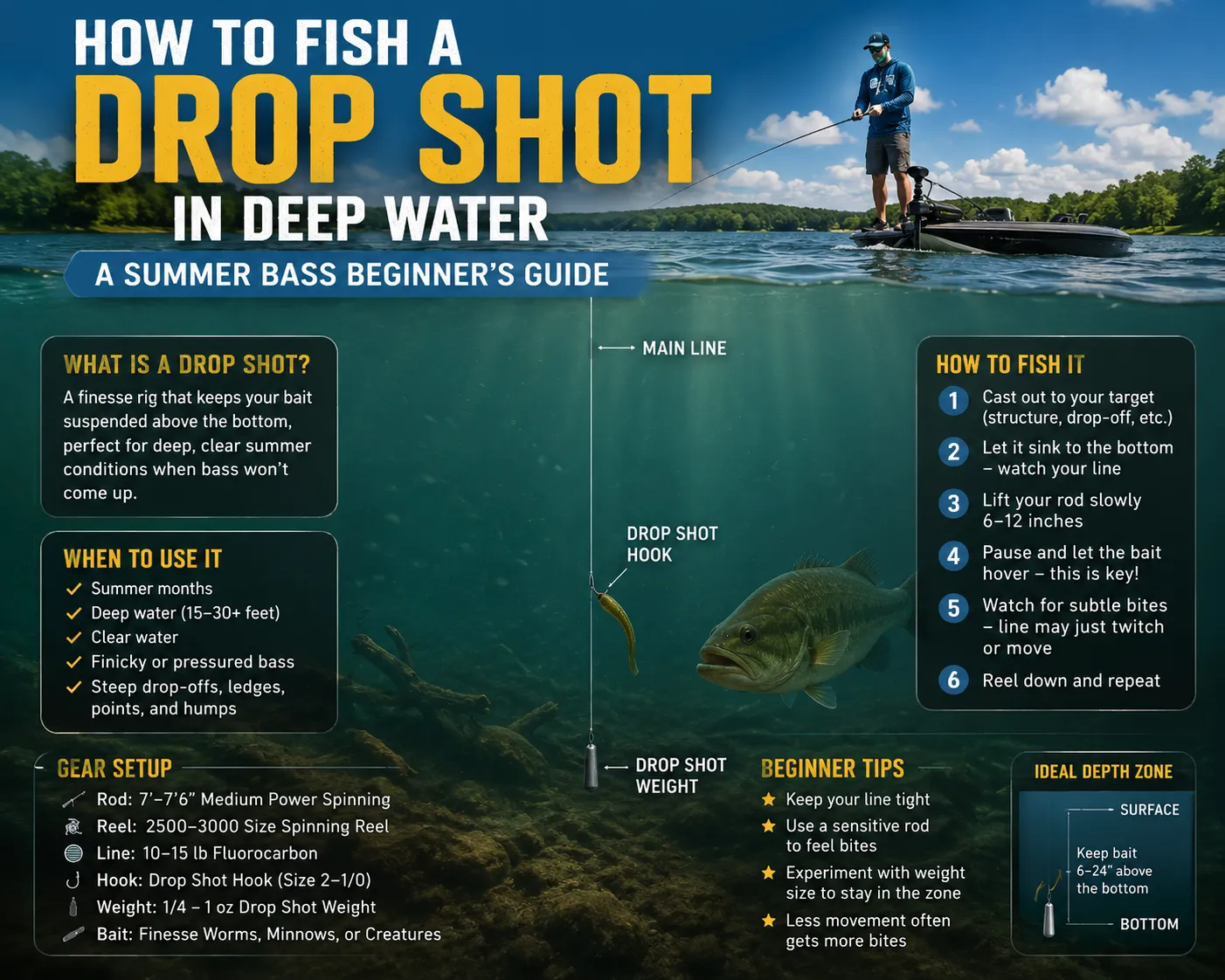
Written by Hudson Reed
The first time I fished a drop shot in deep water, I sat over an 18-foot hump on a 95-degree July afternoon, watched my rod tip do nothing for forty minutes, and reeled in to find a 3-pound smallmouth had been chewing the tail off my worm the whole time. Slack line. No tick. The fish ate it because the bait was sitting still in front of its face, and I almost missed the whole thing because I was looking for the shore-fishing bite I already knew.
That's the gap this guide closes. You can fish a drop shot offshore with the rig you already own (no $4,000 transducer required), but the cadence, the weight, and the way you read a bite are all different than what works from the bank.
To fish a drop shot in deep water for summer bass, tie a 1/0 octopus hook 18 inches above a 3/8-ounce tungsten weight on 8-pound fluorocarbon, position your boat over offshore structure between 12 and 25 feet (the band just above the thermocline), and alternate dead-sticking with subtle shaking on a semi-slack line. Most bites feel like added weight, not a tap.
Why the offshore drop shot eats in summer
When surface temps push past 80 degrees in June, bass slide off the bank and stack on structure between the warm surface layer and the oxygen-starved water beneath the thermocline. They aren't aggressive. They're conserving energy. A bottom-bouncing crankbait gets ignored. A jig gets a halfhearted swat at best.
A drop shot solves three problems at once. The weight sits on bottom and telegraphs structure through the rod. The bait hovers in the strike zone instead of plowing through it. The semi-slack line lets a lethargic bass inhale the worm without feeling resistance and spitting it. Get a small bait suspended at eye level, leave it there, let a hot-water bass make a lazy decision.
The rig, written out so you can tie it from memory
Forget the diagrams for a second. The rig in one paragraph: main line, Palomar knot to a #1 or 1/0 octopus hook, tag end runs back down through the hook eye from the point side so the hook rides up, 18 inches of tag below the hook, weight tied or pinched to the bottom of the tag. The hook rides perpendicular to the line, point up. Weight on bottom. Bait sits eighteen inches off the floor.
Specs that work for offshore summer bass:
- Hook: #1 for 3-inch worms, 1/0 for 4- to 6-inch worms. Owner Mosquito and Gamakatsu Split Shot/Drop Shot hooks are the standards. Nose-hooked for finesse, Texas-rigged through the body for grass or wood.
- Weight: 3/8-ounce tungsten cylinder or teardrop for 15- to 25-foot water. Drop to 1/4-ounce if it's calm and shallow, bump to 1/2-ounce in wind or current. Tungsten matters: it's smaller for the same weight, slides through rock better, and telegraphs bottom composition through the rod like a microphone.
- Leader length (tag end below the hook): 18 inches is the all-around starting point. Go to 24-30 inches if bass are suspended above structure. Shorten to 8-12 inches if they're glued to the bottom.
- Main line: 10-pound braid to a 6-foot, 8-pound fluorocarbon leader connected with an FG or double uni knot. Straight 8-pound fluorocarbon also works if knots intimidate you. It sinks, has low stretch in deep water, and disappears in clear lakes.
Pinch-on weights versus tied-on: pinch-on lets a snagged weight pop free without losing your hook. Tied-on holds better in heavy current. For summer offshore work, pinch-on wins almost every time. You get the hook back when the sinker wedges between two rocks.
What rod, reel, and line actually matter?
A 7-foot to 7-foot-3 medium-light spinning rod with a fast tip is the sweet spot. You need enough tip to feel a 3/8-ounce tungsten ticking 22 feet down and enough backbone to drive a 1/0 hook through a smallmouth's jaw. The St. Croix Bass X, Daiwa Tatula, and Shimano SLX series all have drop-shot-friendly models in the $130 to $250 range as of 2026.
Reel: 2500-size spinning reel, smooth drag, that's about it. You'll spend more time mending line than casting.
Line is where the rig lives or dies. Braid gives you sensitivity and a hookset that actually moves the hook 22 feet down. Fluorocarbon gives you invisibility and sink rate. If you fish one line type, make it 8-pound fluoro straight to the hook. If you fish two, run 10-pound braid to a 6-foot 8-pound fluoro leader. Monofilament floats and stretches, so leave it on the shore rod.
Finding offshore structure without forward-facing sonar
Forward-facing sonar gets the headlines, but plenty of people caught deep summer bass for forty years before it existed. Major League Fishing's 2026 rules restrict FFS to one continuous three-hour segment per competition day, which has nudged even the pros back toward old-school location skills. You don't need live sonar to find a 17-foot hump.
What you actually need:
You might also enjoy: Pike Fishing for Beginners: The Freshwater Predator Most Anglers Overlook
- A lake map. Free options like Navionics WebApp, the Humminbird Chart Viewer, or your state agency's lake-contour PDFs show ledges, humps, points, and channel swings. Mark spots that drop from 8 feet to 20 feet in a short horizontal distance: that's a ledge, and ledges hold fish.
- A 2D sonar or down-imaging unit. Any $300 Lowrance, Garmin, or Humminbird with a transducer on the trolling motor shows bottom depth, hard versus soft bottom, and arches that may or may not be fish. Read the bottom, not the targets. A hard rocky stretch at 18 feet on a long point will hold bass whether you can see them on screen or not.
- A marker buoy or a waypoint. When you find the edge of the structure, drop a marker on the down-current side. Now you can drift or trolling-motor across the spot from multiple angles without losing it.
Position the boat upwind of the structure and use your trolling motor on spot-lock. Cast across the structure rather than vertically over it, especially in clear water (boat shadow on a 15-foot hump puts bass down faster than people realize). Let the weight settle, take up the slack, start working the bait. Track your line angle. If your line drifts 30 degrees off the cast, either you're moving or a fish is.
Dead-sticking versus shaking: when each one wins
This is the part most beginners get wrong, because the internet tells you to shake the rod and you do, and the bass refuses to eat, and you go home thinking the drop shot doesn't work.
It works. You're shaking too much.
"For me, the key seems to be moving the bait very slowly across the bottom but giving it plenty of action by shaking the rod constantly on a limp line."
Boyd Duckett, Bassmaster Elite Series pro, quoted in Bassmaster magazine.
The word "limp" matters more than the word "shake." Tight line moves the weight, which drags the bait through the water in big unnatural sweeps. Semi-slack line vibrates the bait in place without moving the weight at all. The worm quivers. The bass watches. Eventually it eats.
Dead-sticking is the opposite move. You cast, let the weight settle, take up just enough slack to know it's down, and do nothing for 20 to 60 seconds. No shake. No lift. Watch the line where it enters the water. When it twitches sideways, jumps, or goes slack, a bass has the worm.
When to do which:
- Shake when fish are active but suspended, post-frontal pressure is rising, or water temp sits in the 72-to-78-degree comfort zone. Shake on slack line for 5 to 10 seconds, then pause for 10.
- Dead-stick when surface temps push past 84 degrees, after a cold front, or any time you're getting follows but no bites. A 60-second dead-stick on a slow July afternoon catches fish that walked away from a 20-second one.
- Drag-and-pause for covering water on a featureless flat. Reel up, slide the weight one rod length sideways, let it settle, dead-stick 15 seconds, repeat. This is how you find the rock pile inside the bigger structure.
One contrarian opinion that will save you fish: cut your shaking time in half from whatever you think is right. Most beginners shake for 20 seconds and pause for 5. Flip it. Shake for 5, pause for 20. Bass in 18 feet of warm water are not chasing a vibrating worm. They are deciding whether the still one is worth eating.
Drop shot in deep water: a depth-by-temperature cheat sheet for June through August
The thermocline is the dividing line you're fishing to. Above it, oxygen and warmth. Below it, cold dead water with almost no dissolved oxygen, which means almost no fish. Bass live in a band that runs from a few feet above the thermocline up to the bottom of the warm mixed layer.
Per the Kentucky Department of Fish and Wildlife Resources, thermocline depth varies by lake type. Mike Hardin, assistant director of Fisheries, notes that mid-depth clear reservoirs like Green River and Nolin set up around 15 feet, deep clear lakes like Cave Run drop closer to 20 feet, and shallow fertile lakes like Taylorsville only reach about 10 feet before the oxygen quits. Thermocline-depth water on clear lakes runs around 73 degrees Fahrenheit by late summer.
Use those numbers as anchors, then adjust by month:
| Month | Surface temp | Likely thermocline | Drop shot zone | Best structure |
|---|---|---|---|---|
| Early June | 72-78°F | Not yet set or 8-12 ft | 10-18 ft | Secondary points, first deep grass edges, ledges in 10-15 ft |
| Late June / Early July | 78-84°F | 12-20 ft (clear), 8-12 ft (stained) | 15-22 ft | Main-lake humps, channel swing bluffs, isolated brush |
| Mid-July to Mid-August | 83-90°F | 20-28 ft (clear), 10-15 ft (stained) | 18-28 ft (clear), 12-18 ft (stained) | Deep ledges, offshore brush, main-lake points dropping to channel |
| Late August | 80-88°F | 25-35 ft on some highland lakes | 20-35 ft | Same as mid-summer; fish often deepest of the year right before turnover |
Two adjustments matter more than the chart itself.
You might also enjoy: How to Take Your Kids Fishing This Summer: A Parent's Practical Guide
Water clarity beats the calendar. A muddy July lake sets the thermocline shallow because light penetration is shallow. A gin-clear highland reservoir can push fish past 30 feet in the same week. Read the water in front of you, not the date on your phone.
Don't fish below the thermocline. No oxygen down there. If you find a hard line on a 2D sonar where the bottom suddenly gets fuzzy or marks disappear, that's your thermocline. Fish on top of it.
What does a deep-water bite even feel like?
Almost nothing. Honest answer.
In 4 feet of water from the bank, a bass slams a drop shot and the rod loads. In 22 feet of water, the same fish inhales the worm and the only signal is that your line goes from semi-slack to slack, or from slack to tight. Sometimes the rod tip lifts a quarter inch. Sometimes the line just moves sideways.
What to watch for:
- The line angle changes without you moving the rod
- The weight stops telegraphing bottom (like the rig got lighter)
- You set the hook because your line drifted, and there's a fish on it
Hooksets are not the violent jaw-cross sweeps you use for a Texas rig. Reel down until the rod loads, then sweep sideways. A 1/0 finesse hook with 8-pound fluoro under load buries itself. You're establishing pressure, not driving a nail.
How do you keep track of a deep bite when you can't see your rig?
By keeping the line tight to the weight and the weight tight to the bottom, then changing nothing else in the system. Every variable you hold constant (boat position, rod angle, line tension at rest) becomes a baseline you can read against. When something deviates, that's the bite.
This is where logging trips earns its keep. The reason a 17-foot hump fishes well at 82 degrees on overcast July afternoons is almost never one trip last summer. It's the pattern of six trips, and you only see the pattern if you wrote them down. Try Bushwhack to map what depth, temp, and structure produced your last 20 deep-water trips.
A practical first trip plan
If you've never fished offshore before, here's the smallest possible win:
- Pick one main-lake point that drops from 8 feet to 20 feet within a cast length. Use a lake map. You don't need fancy electronics for this.
- Tie one rig: 1/0 hook, 18-inch leader, 3/8-ounce tungsten cylinder, 4-inch finesse worm in green pumpkin (clear water) or junebug (stained). Don't bring three rods. Bring one.
- Position the boat 25 yards off the drop on the upwind side. Cast across the structure, not down it.
- Let the weight settle. Take up slack until you feel it tick. Dead-stick 30 seconds. Shake for 5. Pause for 30. Drag one rod length. Repeat.
- Watch the line. The bite is in the line, not the rod.
If you don't catch one in an hour, move 100 yards and repeat. If you do, mark the depth and the spot. Summer bass live in specific places that produce year after year, and the drop shot is the rig that gets them to eat when nothing else will.
Find your hump.