Middle Provo River Wade Fishing: Access, Parking, and Hatches Mile by Mile
 Cameron Spanos
Written by Cameron Spanos
The first time I walked down to the Middle Provo in late June, I l miss stepped and slipped on a rock and went down hard. I could have caught myself and not slammed into the rocks on the river but I was using my arms to protect my rod. I wasn't being reckless, the Middle Provo is just slick. The bottom looks like clean tan gravel and turns out to be that gravel coated in a thin film of algae that makes felt feel like it's been waxed.
That's the river in one sentence. Easy access, hard wading, and twelve miles of brown trout water that fishes completely differently from one access point to the next.
This is a mile-by-mile Middle Provo River wade fishing guide. Every public access point, what the parking situation actually looks like on a busy Saturday, what's hatching at each one, and where to skip if you want to avoid the crowd at the dam. The river runs roughly 12 miles from Jordanelle Reservoir down to Deer Creek Reservoir through Heber Valley, with seven designated angler-access parking areas built and maintained by the Utah Reclamation Mitigation and Conservation Commission.
Why the Middle Provo fishes differently every mile
The Provo River Restoration Project, completed substantially by 2008, added roughly two miles of river length back into the corridor by reconnecting meanders the old channelization had cut off. What used to be a straight ditch is now braided side channels, undercut banks, and gravel bars. Fish density is high. Park City Fly Fishing Guides cites over 3,000 fish per mile in this stretch, which makes it one of the densest tailwater browns fisheries in the West.
But density doesn't mean uniform. The upper two miles below Jordanelle Dam run cold and clear with classic tailwater character. The middle stretch through Midway gets warmer, broader, and more pocket-water heavy. The lower three miles into Charleston widen out into flats and slow runs that feel like a different river. Hatches show up at the upstream end first and roll downriver. A PMD popping at Charleston in late June already came off at Lunker Lane two weeks earlier.
What does the regulation split mean for where you fish?
The Middle Provo has two different rule books, and the dividing line is Legacy Bridge on Midway Lane (SR-113 between Midway and Heber). This matters whether you're harvesting or not, because the bait-permitted lower section sees different pressure and different fish behavior.
From Legacy Bridge upstream to Jordanelle Dam: artificial flies and lures only, two-fish limit on browns under 15 inches. This is where most fly anglers end up.
From Legacy Bridge downstream to Deer Creek Reservoir: bait is legal, four-fish limit, no size restriction. Per the 2026 Utah Fishing Guidebook, this is the only section of the Middle Provo where you can drift a worm.
Always check the current Utah Division of Wildlife Resources guidebook before fishing. Regulations get updated, and the Provo has special rules that change more often than a typical Utah water.
Mile 0 to 2: Lunker Lane and the upper tailwater
Park at the dam access (officially Jordanelle Dam Lower Stilling Basin) and at Lunker Lane a half-mile down. Two lots, both with vault toilets, both packed by 8 a.m. on weekends from May through October.
This is the densest, coldest, most-pressured water on the river. Tailwater discharge runs in the high 40s°F most of the year, which keeps the bug factory on year-round. It's where you go if you want to hook fish on day one. It's also where you go if you want to fish elbow-to-elbow with three guides, four bachelor parties, and a kid throwing rocks.
The water here is deeper, slower, and more glide-like than people expect from a tailwater. Big seams, foam lines on the inside of every bend, undercut grass banks. Wade in below the bridge at Lunker Lane and work your way up. The casting lanes are obvious. The fish hold tight to the bank.
What's hatching at Lunker Lane
- December through March: Buffalo midges (size 18-22, blackish), heaviest from 11 a.m. to about 2 p.m. when sun hits the water.
- March through May: Blue-winged Olives, sizes 18-20, on overcast afternoons.
- Mid-May through July: Caddis, sizes 14-16. Evening emergences are reliable.
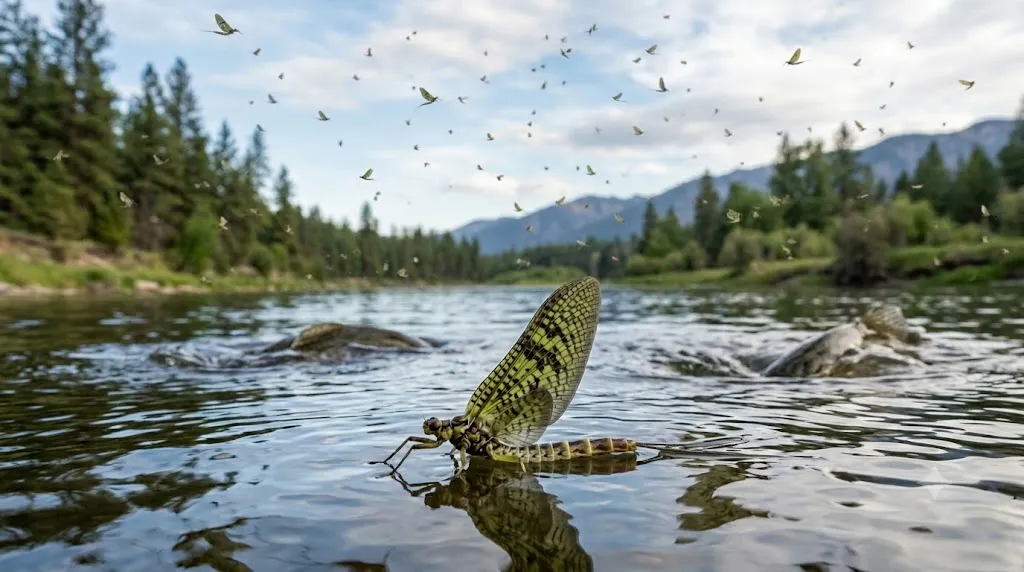
- Late June through August: Pale Morning Duns (PMDs), sizes 14-18. This is the peak Lunker Lane hatch.
- Year-round: Sowbugs and scuds. If nothing's hatching, fish a size 16 sowbug pattern under an indicator and you'll catch fish.
Mile 2 to 4: Rickety Bridge and the upper braids
Down from Lunker Lane the river splits into restored braids. Park at the access marked off River Road past the Casperville turnoff. There's a vault toilet and room for maybe 12 cars, which means it fills up but turns over faster than Lunker Lane.
You might also enjoy: Best All-Around Trout Fly Rod 2026: Sage R8 Core vs Orvis Helios vs Scott Centric vs Douglas Sky G
This is my favorite stretch on the river. The braiding creates more bank than the upper section, which spreads anglers out, and the side channels hold fish that never see a fly. Wade slowly. The braids look shallow and aren't always. I've stepped off what looked like a six-inch bar into water past my knees more than once.
Stoneflies show up here. The Middle Provo has a quiet salmonfly hatch (sizes 6-10) that runs roughly mid-May through July, and the upper braids are where I see them most consistently. Fish a black or gold stonefly nymph as your dropper anywhere in this stretch from spring through summer.
Mile 4 to 6: Bunny Farm and the meadow water
The Bunny Farm access is the meadow stretch most photographers shoot when they post Middle Provo content on Instagram. It looks the way you want a trout river to look: low willows on the banks, smooth gravel runs, fish rising in slow water you can read like a book.
Parking here is smaller and the access trail is longer than the upper points. About a quarter-mile walk to the water from the lot. That filters out a percentage of the drive-up crowd, which is part of the appeal.
Sight fishing is real here. On a sunny mid-summer afternoon I've watched browns work the same seam for ten minutes, refusing pattern after pattern until I dropped down to a size 18 PMD spinner. The fish you can see are the fish you have to outsmart. Not the easy hookups of Lunker Lane.
If you only have time for one access point and you want to actually fish instead of just catch, this is the one.
Mile 6 to 8: Legacy Bridge and the regulation line
Right at Legacy Bridge the rules flip. Park at the lot just north of the bridge to fish flies-only water. Park south to fish where bait is allowed.
The fishing on either side of the bridge is similar (riffle-pool-riffle, gravel bottom, mid-river depth that walks 20 to 36 inches). What changes is the angler mix. Below Legacy you'll see spin fishermen drifting nightcrawlers, kids with worms, and a different demographic than the upstream tailwater crowd. The fish pressure is actually lower here in summer than at Lunker Lane, despite the relaxed regs, because most of the Park City fly crowd refuses to fish below the bridge on principle.
That's a mistake. The bait-section browns are bigger on average. Less catch-and-release pounding, plus the river widens enough to give fish more holding water. I've taken some of my biggest Middle Provo fish from runs I could see the Legacy Bridge from.
Are PMDs as good below Legacy as above?
Yes, and they actually run a few days later down here. Park City Fly Fishing Guides regularly reports PMDs podding fish on dries near Legacy and Charleston in late June and early July, while the upper river has already moved on to terrestrials.
Mile 8 to 10: River Road South and Midway pullouts
Multiple smaller pullouts on the south side of River Road give you scattered access through the Midway agricultural stretch. Two parking areas with toilets at the formal access points, and several unmarked pullouts where there's room for two or three cars on the shoulder.
This stretch is open, exposed, and windier than the upper river. Wind funnels down Heber Valley most afternoons. Plan for it. A 9-foot 5-weight gets pushed around. I'll usually fish a 9-foot 6-weight here in summer just to keep my drift honest in a 15-mph wind.
You might also enjoy: Best Fly Reels for Trout Under $300 (2026): 3 Picks I'd Actually Buy
Terrestrials matter. Hoppers from late July through September, ants and beetles all summer. A size 10 foam hopper with a beadhead pheasant tail dropper is the boring, reliable rig nobody talks about because it's not glamorous. It also out-fishes whatever match-the-hatch rig your buddy is tying on.
Mile 10 to 12: Charleston and the lower flats
The Charleston Bridge access is the last formal parking area before Deer Creek Reservoir. The river here is wide, slower, and warmer than upstream. In late summer when surface temps push 65°F, fish move into the deepest runs and the bite shifts to early morning and evening only.
The flats below Charleston hold the biggest fish in the river. They also see the least pressure and the toughest sight fishing. These browns get a lifetime of fly traffic and they know what's a real PMD and what's a Cripple. Long leaders, light tippet (6X minimum on the dries here, sometimes 7X), and patience.
This is the section where I'd take an experienced angler who is bored with Lunker Lane. It's also the section where a beginner can fish all day and hook nothing, because the fish density is lower and the fish that are there are picky.
Wading the Middle Provo without a swim
This is the part most guides won't tell you in the parking lot. The Middle Provo's gravel is some of the slickest substrate I've fished. The algae film coats the rocks and turns even fresh-soled felt into something close to skis.
"Wade carefully — this river has ended more than a few trips early with wet waders. Wear your wading belt when wading in the Middle Provo."
That's from Jans Mountain Outfitters in Park City, and they're not exaggerating. A few rules I follow:
- Felt with carbide studs, or rubber Vibram with studs. Bare rubber is for people who like cold water.
- Wading staff if the flow is over 350 CFS. The river fishes great at 250-300 CFS but gets pushy fast above 400.
- Wade upstream when you're working a run. You can read the bottom better looking into the current and you control your descent if you slip.
- Don't cross the main channel just because you can see the other bank. The braids are deceptive: looks like 18 inches, turns out to be 38 inches with a soft sand pocket.
- Wading belt. Cinched. Every time.
If you want to track which access points fished best in which conditions, try Bushwhack to log catches by location and water temp. Three trips in, you'll know whether your dry-fly numbers actually hold up at Bunny Farm or whether you just remember the one good evening.
What flow should I look for before driving up?
The Middle Provo fishes best between 200 and 350 CFS. Below 200, the fish stack in the deepest water and get spooky. Above 400, the bank water blows out and you're stuck nymphing the seams you can still reach. Above 600, save the gas. It's a swim, not a wade.
Check flows at the USGS gauge "Provo River near Hailstone" before you drive. Jordanelle releases ramp up in May for irrigation and stay high through July, then drop into a fall window of 150-250 CFS that produces the best dry-fly fishing of the year.
The Middle Provo gear honest take
You don't need a $1,200 rod to fish this water. A 9-foot 5-weight covers 90% of the season. A 10-foot 4-weight if you nymph a lot. Don't bother with anything heavier unless you fish streamers in November.
The thing nobody talks about: bring a net with a soft rubber bag. The Middle Provo has a Whirling Disease history and a fish-handling ethic that runs strong with the local crowd. Knotted nylon mesh kills slime coats and makes you look like a tourist. A 17-inch rubber net runs $40 and it's worth every dollar in fewer dirty looks at the access lot.
If you're bouncing between access points across a season, Bushwhack handles the logging side (water temp, flow, fly that worked, and which exact pullout you parked at). The next time someone asks you what was hatching at Bunny Farm last August, you'll have an answer instead of a guess.